PHYSICAL, CHEMICAL, &
BIOLOGICAL PROPERTIES OF MUNICIPAL SOLID WASTE
4-1 Physical Properties of
MSW
4-2 Chemical Properties of
MSW
4-3 Biological
Properties of MSW
4-4 Physical,
Chemical, & Biological Transformations of Solid Waste
4-1 Physical Properties of
MSW
l Specific Weight
一、 干 擾:不具代表性及大型之廢棄物如電器、家具等,易造成不正確之測定結果,故需先去除,再將大型之廢棄物予以粉碎後均勻混合。
二、 設 備:已知重量之0.1m3之立方體(0.5m×0.5m×0.4m 高)鐵盒(最好為不鏽鋼或鍍鋅材質)或木盒。
三、 步 驟:將於現場所得之樣品裝入盒中,於八分滿時,由兩人提至離地30cm,令其自由落下,使垃圾積實,再填滿樣品,重複三次,秤得總量W1 (kg)。
四、 計 算:單位容積重(kg/m3) = (W1 – W0) /
V
= (W1 – W0) /
V
W1:試樣與容器總重(kg)
W0:容器重(kg)
V:容器體積(0.1 m3)
l Moisture Content
水分(%)=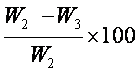
W2= 試樣重
W3=乾重
l Particle Size & Size Distribution
l Field Capacity田間含水量
l Permeability of Compacted Waste
4-2 Chemical Properties of
MSW
l Proximate Analysis
水分、揮發分、固定碳、灰分
(一) 測定樣品之含水份
1.
測試前將坩鍋洗淨後,置於高溫灰化爐中,以1,200℃空燒30分鐘。
2.
空燒後降低爐溫至300℃時,將坩鍋移至乾燥器冷卻備用,使用前秤重。
3.
秤取適量之廢棄物樣品至0.001 g (約5 ~ 10 g),置於上述已秤重之坩鍋中,以105 ±1℃之烘箱乾燥二小時,取出移入乾燥器,冷卻至室溫,秤重。
4.
重覆以上乾燥,冷卻及秤重之步驟,直至前後兩次重量差小於0.005 g為止。
(二) 測定樣品之灰份
1.
將經步驟(一) 4.之樣品置於800±50℃之高溫灰化爐中強熱三小時。
2. 降低爐溫至300℃時,將樣品(連坩鍋)移入乾燥器中冷卻至室溫,秤重。
水分(%)=(W1-W2)
/ W1
灰份(%)=W3
/ W1
W1: 送入烘箱前之樣品重。
W2: 經105℃烘乾後之樣品重。
W3: 經800℃高溫灰化爐灰化後之樣品重。
可燃份=100%-水份(%)-灰份(%)
(三成分分析)
灰份
各成分之乾基灰份Bi(%)=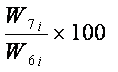
W7i=各成分灰 乾重
W6i=各成分乾重
乾基垃圾灰份B(%)=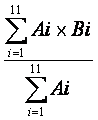
Ai=各物理組成重量百分率
濕基垃圾灰份Br(%)=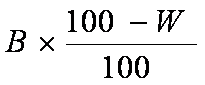
W=垃圾之水分(%)
l Fusing Point of Ash
l Ultimate Analysis
元素分析: C,
H, N, O, S, Cl
(均以濕基表示)
1.
全自動元素分析儀:分析C, H, N﹔S, Cl另分析。
2.
管狀燃燒爐(800C):分析C, H,
S, Cl
a.
水蒸氣用無水氯化鈣或過氯酸鎂(Mg(ClO4)2)吸收﹔二氧化碳用蘇打雲母(Soda
Talc)或氫氧化納吸收,秤其增加重量。
一、 方法概要
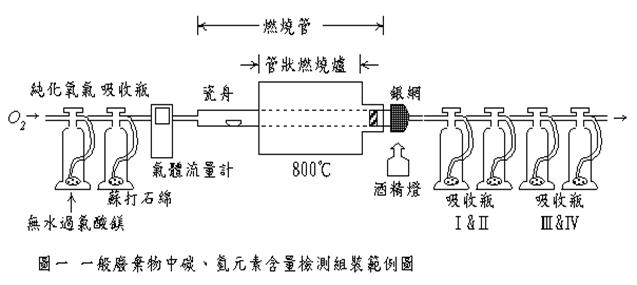
一般廢棄物通入足夠之氧氣,使其在 800 至 850 ℃ 密閉燃燒管中加熱燃燒,廢棄物中的碳(C)、氫(H)氧化產生二氧化碳與水蒸氣分別被蘇打石綿及水分吸收劑吸收。量測吸收劑之增加重量,即得二氧化碳與水之產生量,再予以換算求出一般廢棄物乾基中之碳、氫等元素百分比。
二、 干擾
於燃燒管後端置入銀網,以去除廢棄物中硫及鹵化物所造成偏差。
三、 設備
四、 乾基廢棄物可燃物中各成分元素分析值計算
C(%) = ΔACO2 / W × 12 / 44 × 100(%)
H(%) = ΔAH2O / W × 2 / 18 × 100(%)
C:碳含量 H:氫含量
ΔACO2:二氧化碳吸收劑增重(g)(吸收瓶 Ⅲ 和 Ⅳ 之增重)
ΔAH2O:水分吸收劑增重(g)(吸收瓶 Ⅰ 和 Ⅱ 之增重)
W:樣品乾重(g)
b. 硫,氯用雙氧水吸收,以氫氧化鈉滴定(酸度),再測氯鹽。
一、 方法概要:
一般廢棄物通入足夠之氧氣,使其在 800 至 850 ℃ 密閉燃燒管中加熱燃燒,廢棄物中的硫(S)、氯(Cl)氧化成酸性氣體被 3 % 過氧化氫(H2O2 )溶液吸收。吸收液定量後經滴定法或離子層析法分析即得硫酸根(SO42-)與氯離子(Cl-)產生量,再予以換算求出一般廢棄物乾基中之硫、氯等元素百分比。
二、 步驟
(一)
將管狀燃燒爐電源開關打開,使其溫度達 800 至 850 ℃ 之間。
(二) 為了純化氧氣,分別以無水氯化鈣或無水過氯酸鎂、蘇打石綿吸收瓶串聯接於氧氣瓶及氣體流量計之間,以去除鋼瓶氧氣中之碳和氫的化合物,失效時再予更換。
(三) 將兩支分別裝填 3 % 過氧化氫(約八分滿)的吸收瓶 Ⅰ、Ⅱ 串連後接上導管。
(四) 打開氧氣控制流量約 1500 mL / min。
八、結果處理
元素含量計算:
WS(g)= [SO42-](mg / L)×V(L)/ 1000(mg / g)×32 / 96
WCl(g)= [Cl-](mg / L) ×V(L) / 1000(mg / g)
Si(%)= WSi / W ×100(%)
Cli(%)= WCli / W ×100(%)
WS:硫元素重量(g)
WCl:氯元素重量(g)
V:吸收液體積(L)
[SO42-]:由離子層析法測得吸收液中硫酸根濃度(mg / L)
[Cl-]:由滴定法或離子層析法測得吸收液中氯離子濃度(mg / L)
Si:硫元素含量(%)
Cli:氯元素含量(%)
i:一般廢棄物可燃物種類
W:樣品乾重(g)
3.
凱氏氮法(Kjeldahl Nitrogen)分析N (氨氮+有機氮)
4.
可燃份 - C, H, N, S, Cl = O
l Energy Content (Heating Value)
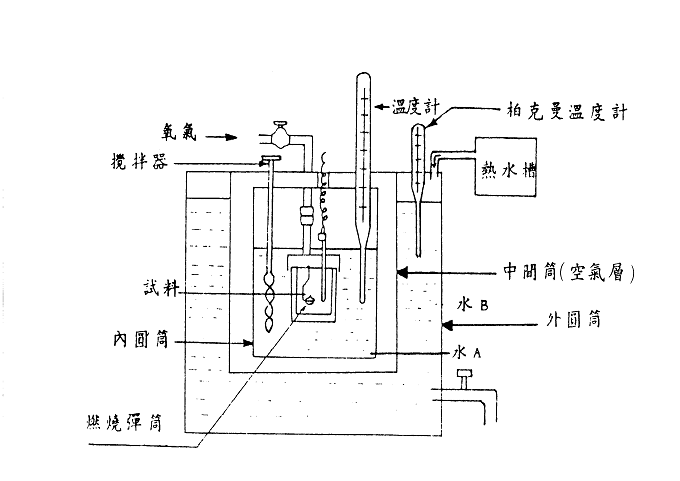
利用熱量計Bomb Calorimeter分析
 一、方法概要
將樣品置入熱卡計內,再置於附有絕熱式夾套之水浴槽中,點火燃燒後,樣品所釋放之燃燒熱,由外圍水浴槽吸收,紀錄水浴槽上昇之溫度,乘上水及熱卡計水當量之和,乘上水之比熱,再除以樣品重量,即可求得樣品之熱值。
各類樣品乾基發熱量Hi (kcal/kg)×樣品重(kg)+發熱補正值(kcal)=上昇溫度×水比熱×(內筒水重+水當量)
水當量:熱量計吸收的熱量換算成若干重量的水吸收之熱量,用已知發熱量之標準樣品苯甲酸(Benzoic Acid)進行實驗,即可求出水當量。
發熱補正值:點火用的鎳絡線與包覆樣品用的雁皮紙所含的熱量
溫度測量:柏克曼溫度計(Berkman Thermometer)
垃圾樣品乾基發熱量H (kcal/kg)=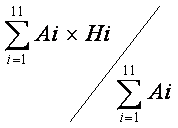
濕基高位發熱量Hh=H×
濕基低位發熱量Hl=
Hh – 6 (9 H+W)
6: 水蒸發潛熱600
kcal/kg,H: 氫濕基重量百分比
焚化爐中水為氣態,熱量計中水為液態,水由氣態冷凝至液態釋放出凝結熱(蒸發潛熱)。低位發熱量才是焚化爐中垃圾實際能釋放的熱量。
由三成分分析推估發熱量Hl=
45 V – 6 W
V: 可燃份(%)(濕基)
45:
纖維素(C6H10O5)n之乾基發熱量4,500 kcal/kg
本多氏三成分推估Hl=
44.75 V – 5.8 W + 21.2
由物理組成推估發熱量
小林氏推估Hl=
(80 R+45 V) × – 6 W
R: 塑膠重量百分比(乾基)
V: 塑膠以外之可燃物重量百分比(乾基)
Hl= [88.2 R+40.5(G + P)] × – 6 W
R: 塑膠重量百分比(乾基)
G: 廚餘重量百分比,P: 紙類重量百分比(乾基)
由元素分析推估
Dulong式
Hl= 81 C + 342.5 (H – O/8) +
22.5 S – 6 (9 H + W)
假設樣品中之氧全部為化合水狀態
81:
碳之乾基發熱量8,100
kcal/kg
342.5: 氫之乾基發熱量34,250 kcal/kg,化合水中之氫燃燒時不放熱,故應扣除(H : O = 2 : 16,結合水中之氫H = O/8,H: 氫濕基重量百分比)
Scheurer – Kestner 式
Hl=
81 (C – 3O/4) + 342.5 H + 22.5 S + 57×3O/4 – 6 (9 H + W)
假設樣品中之氧全部為:C=O狀態
(C –3O/4): 以CO狀態結合之碳燃燒時,故應扣除(C : O = 12 : 16, 結合之碳 C = 3O/4,C: 碳濕基重量百分比)
57: CO之乾基發熱量5,700 kcal/kgC
Steuer 式
Hl= 81 (C – 3O/8) + 57×3O/8 + 345 (H –
O/16) + 25 S – 6 (9 H + W)
假設樣品中之氧一半為結合水之狀態,另一半為:C=O狀態
焚化灰渣灼燒減量(Ignition Loss):焚化後灰渣樣品以600℃燃燒三小時損失之重量。用於評估燃燒效率。
(一)全連續式焚化處理設施:
每日燃燒量200公噸以上者在5%以下。
每日燃燒量未達200公噸者在7%以下。
(二)準連續式焚化處理設施每日燃燒量40公噸至180公噸者在7%以下。
(三)分批填料式焚化處理設施在10%以下。
(一般廢棄物回收清除處理辦法)
l Essential Nutrients
C/N, P
4-3
Biological Properties of MSW
Excluding plastic, rubber, & leather,
organic fraction can be classified as:
l Water soluble constituents: sugars,
starches, amino acids, organic acids.
l Hemicelluloses: 5-, 6-carbon sugars.
l Cellulose: 6-carbon sugars, glucose.
l Fats, oils, & Waxes: ester of alcohol
& long-chain fatty acids.
l Lignin.
l Lignocelluloses: combination of lignin
& cellulose.
l Proteins: amino acids.
1.
Biodegradability
of Organics
BF=0.83-0.028 LC
BF: biodegradable fraction expressed on a volatile solids (VS)
basis
LC: lignin content of VS (dry basis)
(Table 4-7)
2.
Odor
production
H2S,
CH3SH.
4-4 Physical, Chemical, & Biological
Transformations of Solid Waste
l Physical transformation
(1)
Component
separation:
To transform a heterogeneous waste into a number of
homogeneous components by manual and mechanical means.
(2)
Mechanical
volume reduction:
Densification, to reduce storage & handling
costs, shipping costs, transport costs, to increase the useful life of
landfill.
(3)
Mechanical
size reduction:
Shredding, grinding, milling, to obtain a product
that is reasonably uniformly & reduced in size (not necessarily).
l Chemical transformation
Typically involve a change of phase, to reduce the
volume, to recovery conversion products.
(1)
Combustion
(incineration):
Chemical reaction of O2 with organic
materials, with excess air, generation of heat, off gases, ashes (bottom ash,
fly ash).
(2)
Pyrolysis
(thermal cracking):
Reaction in an oxygen-free atmosphere, into gaseous,
liquid, and solid fractions.
a.
Gas: H2, CH4, CO, CO2, others
b.
Tar & oil: acetic acid, acetone, and methanol.
(C6H8O)
c.
Char: carbon, inert.
(3)
Gasification:
Partial combustion & pyrolysis:同一爐內,以燃燒提供熱解所需之熱能。
(4)
Other processes:
Hydrolysis, fermentation.
l Biological transformation
Aerobic or anaerobic reaction
(1)
Composting:
(aerobic)
Under controlled conditions (O2, H2O,
Temp., Nutrient), organic fraction can be converted to a stable humus-like
product in 4 – 6 weeks. (Solid-phase fermentation)
Organic matter + O2 +
nutrients à new cells +resistant organic matter
(lignin, humus) + CO2 + H2O + NH3 + SO42-
+ heat
(2)
Anaerobic
digestion:
Gas: CO2, CH4, NH3,
H2S.
Residuals: digested sludge.
(3)
Others:
high-solid anaerobic digestion (Chapter
14).
l Importance of Waste Transformations in Solid Waste
Management
(1)
Improving
efficiency of solid waste management systems
Storage, collection, transportation, treatment,
final disposal.
(2)
Recovery of
materials for reuse and recycling
(3)
Recovery of
conversion products and energy:
a.
Combustion to
produce steam and electricity.
b.
Pyrolysis to produce a synthetic fuel.
c.
Gasification to
produce a synthetic fuel.
d.
Biological
conversion to produce compost.
e.
Digestion to
generate methane and humus.